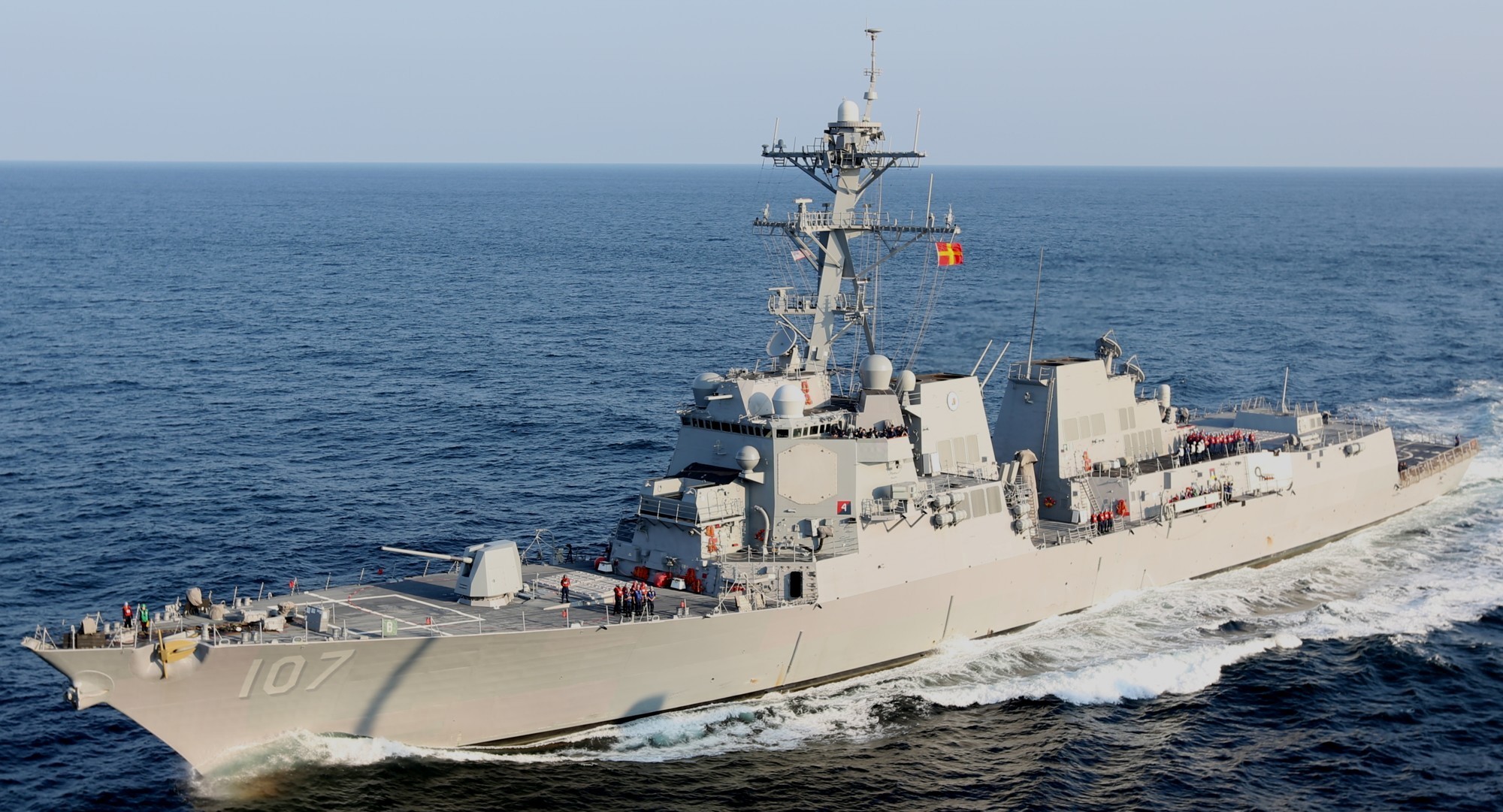
Caribbean Power Projection

Oct 29, 2025

USS Gravely's Trinidad deployment and the Ford carrier strike group create opportunities in maritime domain awareness, partner capacity building, and regional security technology.

Caribbean Power Projection

Oct 29, 2025

USS Gravely's Trinidad deployment and the Ford carrier strike group create opportunities in maritime domain awareness, partner capacity building, and regional security technology.

The USS Gravely's arrival in Port-of-Spain this week represents more than routine naval diplomacy. With the Gerald R. Ford carrier strike group operating nearby, the US is executing a calculated maritime strategy that creates immediate opportunities for defense technology providers specializing in distributed operations, maritime domain awareness, and partner capacity building.

Strategic Geography Meets Modern Naval Power

Trinidad and Tobago sits just seven miles from Venezuela's coast—closer to Caracas than many Venezuelan naval bases. This proximity transforms the island nation from a Caribbean afterthought into a strategic pivot point for regional security operations. The USS Gravely's port call isn't about showing the flag; it's about establishing sustainable presence in contested waters where state threats merge with transnational criminal networks.

The Arleigh Burke-class destroyer brings formidable capabilities to this theater. Its Aegis Combat System and SPY-1D radar can track hundreds of targets simultaneously while managing engagements across air, surface, and subsurface domains. The ship's 96-cell Vertical Launch System accommodates everything from Tomahawk land-attack missiles to SM-3 ballistic missile interceptors. This represents massive overmatch for regional threats, but that's precisely the point—establishing escalation dominance while maintaining flexibility for lower-intensity operations.

The planned joint exercises with Trinidad and Tobago Defence Force reveal the actual strategic play—These are capability development opportunities that create lasting dependencies on US systems and doctrine. Every Trinidad naval officer who trains on US equipment becomes a future advocate for American defense solutions. Every successful joint operation validates interoperability requirements that favor US-compatible systems. This pattern of allied arms cooperation has proven effective across multiple theaters.

The Technology Transfer Opportunity

Small nation capacity building represents an underappreciated market segment with exceptional growth potential. Trinidad and Tobago's entire defense budget approximates the cost of a single F-35, yet their maritime security requirements are genuine and expanding. This creates demand for "right-sized" solutions—systems sophisticated enough to address modern threats but sustainable for nations with limited defense infrastructure.

Consider the immediate requirements: Trinidad needs persistent maritime surveillance to monitor Venezuelan activities and drug trafficking routes. They require secure communications to coordinate with US forces. They need data fusion capabilities to transform sensor inputs into actionable intelligence. Each requirement represents a procurement opportunity for companies offering scalable, user-friendly systems that don't require extensive operator training or maintenance infrastructure.

The modular mission systems market deserves particular attention. Companies developing containerized ISR packages, deployable communications nodes, or plug-and-play sensor suites that can transform basic patrol vessels into capable security platforms will find eager customers. The key is balancing sophistication with sustainability—systems that deliver 80% capability at 20% lifecycle cost win in this market.

Maritime Domain Awareness as the New Battleground

The Caribbean's transformation into a contested maritime space drives demand for persistent surveillance capabilities that traditional naval patrols can't provide. Drug traffickers use semi-submersibles, go-fast boats, and commercial vessels to move product. State actors blend military operations with criminal activities. This complexity requires layered sensor networks that can distinguish threats from legitimate traffic in congested waters.

Unmanned systems offer compelling solutions. Small unmanned surface vessels (USVs) can maintain persistent presence in key transit areas. Unmanned aerial vehicles (UAVs) provide wide-area surveillance without risking crews—a capability demonstrated by recent MQ-9B acquisitions in the Middle East for maritime patrol missions. Underwater unmanned vehicles (UUVs) monitor subsurface activity where semi-submersibles operate. Companies integrating these platforms into coherent operational pictures capture premium valuations.

Artificial intelligence becomes essential for processing the data deluge. Machine learning algorithms that can identify anomalous vessel behavior, predict trafficking routes, or correlate disparate sensor inputs transform raw data into decision advantage. The companies developing these capabilities for the Pentagon can adapt them for partner nations, creating new revenue streams with minimal additional development.

The Venezuela Variable

Venezuela's response—threatening to cut energy supplies to Trinidad—exposes critical infrastructure vulnerabilities that defense planners must address. This energy weaponization creates immediate demand for resilience technologies: backup power systems for critical defense infrastructure, alternative energy solutions reducing dependence on Venezuelan supplies, and cybersecurity capabilities protecting energy distribution networks.

The broader Venezuela challenge extends beyond energy. Their growing military cooperation with Russia and China introduces advanced capabilities into the region—from Su-30 fighters to Chinese naval vessels. This drives requirements for counter-capabilities: electronic warfare systems to disrupt adversary communications, counter-drone technologies to defeat surveillance platforms, and cyber tools to compromise adversary networks.

Companies offering asymmetric solutions that allow smaller forces to counter larger adversaries find receptive markets. Think electronic warfare systems that can blind sophisticated radars, cyber tools that corrupt adversary data, or deception technologies that multiply apparent force strength. The lessons from Ukraine's innovation ecosystem demonstrate how smaller nations can leverage commercial technology against conventional military advantages.

CARICOM's Divided Response Creates Market Fragmentation

The regional response reveals market complexity worth understanding. CARICOM's call for dialogue contrasts with Trinidad Prime Minister Persad-Bissessar's harder security stance. This divergence means no single security solution fits all Caribbean nations. Companies must offer flexible architectures adaptable to different threat perceptions and political constraints.

Barbados might prioritize hurricane response and disaster relief capabilities. Jamaica focuses on counter-narcotics operations. The Bahamas needs maritime patrol aircraft for vast territorial waters. Each requirement creates niche opportunities for specialized providers who understand local dynamics beyond just technical specifications.

The non-lethal technology segment deserves emphasis. Many Caribbean nations prefer capabilities that disable rather than destroy: acoustic devices that disorient, entanglement systems that stop vessels, or directed energy weapons that disable electronics. Companies developing these "escalation management" tools find markets beyond just the Caribbean—any nation managing complex security challenges without wanting lethal engagement benefits from these capabilities.

Investment Vectors and Market Timing

Near-term opportunities cluster around immediate operational requirements. The joint exercises will reveal capability gaps that need rapid solutions. Emergency procurement authorities can accelerate acquisition timelines from years to months for critical capabilities. Companies with existing products requiring minimal modification capture these quick-reaction contracts.

Medium-term value creation comes from foreign military sales (FMS) cases as Caribbean nations formalize capability requirements identified during exercises. These multi-year programs provide predictable revenue streams and establish long-term customer relationships. The key is navigating the FMS process efficiently—companies with experienced international business development teams gain competitive advantage.

Long-term opportunities emerge from regional security architecture development. As Caribbean nations enhance maritime cooperation, they'll need interoperable systems enabling information sharing and coordinated operations. Companies providing enterprise-level solutions—regional command centers, integrated sensor networks, or secure communication backbones—position themselves for decade-long engagements.

Risk Mitigation in Volatile Markets

Political instability remains the primary risk. Government changes can alter security priorities overnight. Companies should structure contracts with appropriate termination clauses and payment schedules that front-load cost recovery. Partnering with local firms provides political insurance and satisfies industrial participation requirements.

Technology transfer restrictions could limit market access. ITAR and export control regulations may prevent selling advanced capabilities to certain nations. Companies should develop export-compliant variants of their systems early, avoiding delays when opportunities emerge. Understanding which technologies face fewer restrictions provides competitive advantage.

Currency fluctuations and payment risks require attention. Many Caribbean nations face economic pressures that could affect payment reliability. Dollar-denominated contracts, multilateral funding mechanisms, and payment guarantees from international financial institutions help manage these risks.

The Competitive Landscape

Traditional defense primes initially overlooked the Caribbean market as too small for attention. This creates opportunities for mid-tier companies and innovative startups to establish positions before giants arrive. Companies like Textron with its aerostats, Elbit with its maritime patrol aircraft, and Leonardo with its naval systems already recognize the opportunity.

The Chinese alternative merits consideration. Beijing offers attractive financing and fewer restrictions on technology transfer. However, US security partnerships create strong preferences for American or allied systems. Companies that can match Chinese pricing while offering superior capability and training support will win competitions.

Reading the Signals

The USS Gravely's deployment represents a sustained US commitment to Caribbean security that will drive defense requirements for years. Companies positioned to support distributed maritime operations, partner capacity building, and asymmetric threat response will find expanding markets as this commitment translates into procurement programs.

The convergence of state threats, transnational crime, and energy security in the Caribbean creates complex challenges requiring innovative solutions. Defense investors who recognize this complexity and identify companies offering adaptable, sustainable capabilities will capture value as the region transforms from strategic backwater to contested maritime frontier.


The USS Gravely's arrival in Port-of-Spain this week represents more than routine naval diplomacy. With the Gerald R. Ford carrier strike group operating nearby, the US is executing a calculated maritime strategy that creates immediate opportunities for defense technology providers specializing in distributed operations, maritime domain awareness, and partner capacity building.

Strategic Geography Meets Modern Naval Power

Trinidad and Tobago sits just seven miles from Venezuela's coast—closer to Caracas than many Venezuelan naval bases. This proximity transforms the island nation from a Caribbean afterthought into a strategic pivot point for regional security operations. The USS Gravely's port call isn't about showing the flag; it's about establishing sustainable presence in contested waters where state threats merge with transnational criminal networks.

The Arleigh Burke-class destroyer brings formidable capabilities to this theater. Its Aegis Combat System and SPY-1D radar can track hundreds of targets simultaneously while managing engagements across air, surface, and subsurface domains. The ship's 96-cell Vertical Launch System accommodates everything from Tomahawk land-attack missiles to SM-3 ballistic missile interceptors. This represents massive overmatch for regional threats, but that's precisely the point—establishing escalation dominance while maintaining flexibility for lower-intensity operations.

The planned joint exercises with Trinidad and Tobago Defence Force reveal the actual strategic play—These are capability development opportunities that create lasting dependencies on US systems and doctrine. Every Trinidad naval officer who trains on US equipment becomes a future advocate for American defense solutions. Every successful joint operation validates interoperability requirements that favor US-compatible systems. This pattern of allied arms cooperation has proven effective across multiple theaters.

The Technology Transfer Opportunity

Small nation capacity building represents an underappreciated market segment with exceptional growth potential. Trinidad and Tobago's entire defense budget approximates the cost of a single F-35, yet their maritime security requirements are genuine and expanding. This creates demand for "right-sized" solutions—systems sophisticated enough to address modern threats but sustainable for nations with limited defense infrastructure.

Consider the immediate requirements: Trinidad needs persistent maritime surveillance to monitor Venezuelan activities and drug trafficking routes. They require secure communications to coordinate with US forces. They need data fusion capabilities to transform sensor inputs into actionable intelligence. Each requirement represents a procurement opportunity for companies offering scalable, user-friendly systems that don't require extensive operator training or maintenance infrastructure.

The modular mission systems market deserves particular attention. Companies developing containerized ISR packages, deployable communications nodes, or plug-and-play sensor suites that can transform basic patrol vessels into capable security platforms will find eager customers. The key is balancing sophistication with sustainability—systems that deliver 80% capability at 20% lifecycle cost win in this market.

Maritime Domain Awareness as the New Battleground

The Caribbean's transformation into a contested maritime space drives demand for persistent surveillance capabilities that traditional naval patrols can't provide. Drug traffickers use semi-submersibles, go-fast boats, and commercial vessels to move product. State actors blend military operations with criminal activities. This complexity requires layered sensor networks that can distinguish threats from legitimate traffic in congested waters.

Unmanned systems offer compelling solutions. Small unmanned surface vessels (USVs) can maintain persistent presence in key transit areas. Unmanned aerial vehicles (UAVs) provide wide-area surveillance without risking crews—a capability demonstrated by recent MQ-9B acquisitions in the Middle East for maritime patrol missions. Underwater unmanned vehicles (UUVs) monitor subsurface activity where semi-submersibles operate. Companies integrating these platforms into coherent operational pictures capture premium valuations.

Artificial intelligence becomes essential for processing the data deluge. Machine learning algorithms that can identify anomalous vessel behavior, predict trafficking routes, or correlate disparate sensor inputs transform raw data into decision advantage. The companies developing these capabilities for the Pentagon can adapt them for partner nations, creating new revenue streams with minimal additional development.

The Venezuela Variable

Venezuela's response—threatening to cut energy supplies to Trinidad—exposes critical infrastructure vulnerabilities that defense planners must address. This energy weaponization creates immediate demand for resilience technologies: backup power systems for critical defense infrastructure, alternative energy solutions reducing dependence on Venezuelan supplies, and cybersecurity capabilities protecting energy distribution networks.

The broader Venezuela challenge extends beyond energy. Their growing military cooperation with Russia and China introduces advanced capabilities into the region—from Su-30 fighters to Chinese naval vessels. This drives requirements for counter-capabilities: electronic warfare systems to disrupt adversary communications, counter-drone technologies to defeat surveillance platforms, and cyber tools to compromise adversary networks.

Companies offering asymmetric solutions that allow smaller forces to counter larger adversaries find receptive markets. Think electronic warfare systems that can blind sophisticated radars, cyber tools that corrupt adversary data, or deception technologies that multiply apparent force strength. The lessons from Ukraine's innovation ecosystem demonstrate how smaller nations can leverage commercial technology against conventional military advantages.

CARICOM's Divided Response Creates Market Fragmentation

The regional response reveals market complexity worth understanding. CARICOM's call for dialogue contrasts with Trinidad Prime Minister Persad-Bissessar's harder security stance. This divergence means no single security solution fits all Caribbean nations. Companies must offer flexible architectures adaptable to different threat perceptions and political constraints.

Barbados might prioritize hurricane response and disaster relief capabilities. Jamaica focuses on counter-narcotics operations. The Bahamas needs maritime patrol aircraft for vast territorial waters. Each requirement creates niche opportunities for specialized providers who understand local dynamics beyond just technical specifications.

The non-lethal technology segment deserves emphasis. Many Caribbean nations prefer capabilities that disable rather than destroy: acoustic devices that disorient, entanglement systems that stop vessels, or directed energy weapons that disable electronics. Companies developing these "escalation management" tools find markets beyond just the Caribbean—any nation managing complex security challenges without wanting lethal engagement benefits from these capabilities.

Investment Vectors and Market Timing

Near-term opportunities cluster around immediate operational requirements. The joint exercises will reveal capability gaps that need rapid solutions. Emergency procurement authorities can accelerate acquisition timelines from years to months for critical capabilities. Companies with existing products requiring minimal modification capture these quick-reaction contracts.

Medium-term value creation comes from foreign military sales (FMS) cases as Caribbean nations formalize capability requirements identified during exercises. These multi-year programs provide predictable revenue streams and establish long-term customer relationships. The key is navigating the FMS process efficiently—companies with experienced international business development teams gain competitive advantage.

Long-term opportunities emerge from regional security architecture development. As Caribbean nations enhance maritime cooperation, they'll need interoperable systems enabling information sharing and coordinated operations. Companies providing enterprise-level solutions—regional command centers, integrated sensor networks, or secure communication backbones—position themselves for decade-long engagements.

Risk Mitigation in Volatile Markets

Political instability remains the primary risk. Government changes can alter security priorities overnight. Companies should structure contracts with appropriate termination clauses and payment schedules that front-load cost recovery. Partnering with local firms provides political insurance and satisfies industrial participation requirements.

Technology transfer restrictions could limit market access. ITAR and export control regulations may prevent selling advanced capabilities to certain nations. Companies should develop export-compliant variants of their systems early, avoiding delays when opportunities emerge. Understanding which technologies face fewer restrictions provides competitive advantage.

Currency fluctuations and payment risks require attention. Many Caribbean nations face economic pressures that could affect payment reliability. Dollar-denominated contracts, multilateral funding mechanisms, and payment guarantees from international financial institutions help manage these risks.

The Competitive Landscape

Traditional defense primes initially overlooked the Caribbean market as too small for attention. This creates opportunities for mid-tier companies and innovative startups to establish positions before giants arrive. Companies like Textron with its aerostats, Elbit with its maritime patrol aircraft, and Leonardo with its naval systems already recognize the opportunity.

The Chinese alternative merits consideration. Beijing offers attractive financing and fewer restrictions on technology transfer. However, US security partnerships create strong preferences for American or allied systems. Companies that can match Chinese pricing while offering superior capability and training support will win competitions.

Reading the Signals

The USS Gravely's deployment represents a sustained US commitment to Caribbean security that will drive defense requirements for years. Companies positioned to support distributed maritime operations, partner capacity building, and asymmetric threat response will find expanding markets as this commitment translates into procurement programs.

The convergence of state threats, transnational crime, and energy security in the Caribbean creates complex challenges requiring innovative solutions. Defense investors who recognize this complexity and identify companies offering adaptable, sustainable capabilities will capture value as the region transforms from strategic backwater to contested maritime frontier.

Let’s bring your vision to life

Extreme close-up black and white photograph of a human eye

Contact us

Let’s bring your vision to life

Extreme close-up black and white photograph of a human eye

Contact us

Let’s bring your vision to life

Extreme close-up black and white photograph of a human eye

Contact us